Friday, September 30, 2005

To Be Frank, Times Have Changed. Let's Get That Straight.


My good friend Frank, who I've written about before, used to be married to a woman named Donna. Donna had a close friend, Jim, who was gay. I say that in the past tense because Jim is no longer amongst the living. Frank and I used to try to get him to go straight, with no luck, so we finally gave up and accepted the fact that he was never going to be into women. Jim was really a very good guy and I always enjoyed his company.

Whenever Frank and Donna had parties, Jim would be there. He really made the parties more fun. Frank would do his ostrich impersonation. He could do a fly, a frog and probably a couple more. They were fun times.


Early one evening, Frank & Donna had a dinner party. He was always a good cook and every time we went for dinner, he made some kind of gourmet meal. On this particular evening, later on after most of the guests left, Jim convinced the women, including my girlfriend, that we had to go out dancing. To a gay nightclub. We had to go. The women said so. Disco was the rage back then and Frank and I hated disco.

We hopped in cars and drove to this club called January's, in New Hope, Pennsylvania. Boom, ba boom boom boom. We could hear the pulsating sounds of the intense music in the parking lot as we pulled in.

"Oh, boy. Can't wait," Frank and I said to ourselves.


In we went. I probably never held on to my girlfriend that tightly before. We noticed that to the left was a room that had a pool table or two and a few TVs probably playing a Bette Midler special. To the right, was the lighted dance floor. "Come on! Let's go into the dance club!" the girls exclaimed. So we did. I had never seen men in platform shoes dancing together before, gyrating their ugly rearends to the rhythm of heavy drum beats. Black lights. Strobe lights everywhere.


"Let's dance," the girls screamed.


Frank and I looked at each other and said in tandem, "There's no way I'm going out on that dance floor with a bunch of gay men!"


"You have to."


"No. You made us come here. You can't make us dance." Besides, those men would have made me look more spastic than Joe Cocker on his worst day.


"Fine, then." And off they went, disappearing into the bowels of Disco Heaven. Jim was already out there somewhere.


I asked Frank, "What happens if we need to use the men's room?" He freaked.


We decided to go into the other room to play pool. It was much quieter. Maybe it was a Donna Summer or Barbra Streisand concert on television instead. Back in those days, you could line quarters up all around the table, to keep it. We did. That pool table was going to be our security blanket for the rest of the evening. We started to play. Frank was always a better pool player than me. I was singing "Shoot, Frankie, Shoot, doo, doo, doodle-ee-yoo," to myself to the tune of "Fly, Robin, Fly."
He was winning most of the games up to that point, until...

Well, I was standing there as Frank was shooting, leaning against my pool stick in front of me. All of a sudden, I felt something brush against my arm. Some guy was nudging me with his. "Hey, I've been watching you. You're a really good pool player." Hmmm. I thought about it. Now, I was on his turf. I wasn't about to yell, "Get away from me, you faggot!" I had to think fast. Besides, I was never quite the homophobe Frank was.


"You see my "friend" Frankie shooting?"


"Yes?"


Frank was going to be my squeeze that night whether he liked it or not. "He's got a pool table at home and he has a really big stick."


"Oh, OK," and off he went.

I went up to Frank and asked him if he saw that guy.


"Yes. What was he doing, trying to hit on you, Dave? You might have had a fun experience."


When I told him how I got rid of him, Frank yelled, "Ew, yuck. That's disgusting," and a few other choice expletives. He never won another game that night.

Monday, September 26, 2005

Government In Action?


Stolen_Tag
Originally uploaded by Marinade Dave.
I was working for a company in south Orlando. I lived north of the city in another county. Late one morning, one of the sales reps came into my office to tell me my license plate was no longer on my vehicle. Well, what should I do, I thought. I decided to call the Florida Highway Patrol to report that my tag was stolen. The dispatcher asked me what county was it stolen from? I said, I would assume Orange since that was the county I was in. She said I needed to call the Orange County Sheriff's Department. I did. Of course I had to look up these phone numbers since this wasn't a 911 emergency call. No big deal, right?

"Yes, I'd like to report my tag stolen."

"Where was it stolen?"

"Orange County." At least, that was my story and I was sticking to it. I didn't think I could have driven all the way from home to work without being detected by an alert law enforcement official. She asked for my information.

"You live in Seminole County?"

"Yes."

"Then you have to report it stolen there."

"But I think it was stolen here."

"It doesn't matter where it was stolen. You have to report it to the county in which you reside." I didn't want to argue with her about that and she did give me the number of the Seminole County Sheriff's Department. So I called and told her of my predicament. This time, the dispatcher sounded like she didn't trust me. Like I was guilty of something.

"You need to have the vehicle towed to Seminole County and call us from there." She was not being friendly.

"What do you mean, towed? Why don't I just make one of those 'Stolen Tag' signs and affix it to the back of my car and drive it up?"

"That is illegal. You can have your car impounded for an improper tag if you are pulled over. You must have it towed."

"But that's going to cost me $80 for something I had no control over." I was already trying to figure out alternatives. "Anyway, after I call you back, then what happens?"

"Within 2 hours a deputy will arrive and take your statement and write a report about your tag being stolen. You will have to purchase a new tag, plus pay a $10 fee for writing up the report. Upon receival by the state, they will issue you a $10 refund through the mail."

I said, "That's not very fair. I have to pay $80 to have my car towed, some $10 fee, plus the cost of a new tag? Suppose my tag was stolen in Miami? I'd have to have my car towed here from all the way down there?"

"Yes, sir."

Again, I said that it wasn't fair.

"That's your problem."

"OK, then. Is this phone call being recorded?"

"Yes, sir."

"Good. Then I want to report that my license plate has been stolen. Thank you." Click.

There was a motor vehicle tag office right down the street from where I worked, so I called them and explained my situation and what I had just gone through. She laughed.

"Don't worry. Get yourself a ride down here. Bring in your registration and we'll issue you a new tag."

That's what I did. I saved $90 by not doing it the official "police" way. But, I was absolutely legal with the state, and to me, that was all that mattered. If someone used the tag and got into trouble, I would refer to my official government recorded conversation.

With all of the hurricane damage and response time, I wonder if it works the same way. One agency nails you to the wall and the other one unscrews you. And none the wiser to each other. Bureaucracy.

Thursday, September 22, 2005

Heaven Sent


Well, well, Three Angels Gourmet did it again. I got a package of their Heavenly Jam Bar Mix and promptly gave it to my mother. I'm one of those fortunate ones who, at my age, is lucky enough to have both of my parents around. And, I'm certainly blessed that my mother has always been an excellent cook, so it was no problem coaxing her into making something with it. She thought about making jam bars, but then she saw another recipe suggestion for Heavenly Apple Crumble. She just happened to have a few apples laying around, so no arm twisting was required. She sprinkled cinnamon over the sliced apples and added water. Then she melted a stick of butter and stirred that in the mix. After pouring that over the apples and baking, voila! A perfect dessert treat! By the time I got there, it was about half gone. It was only by divine intervention that I got the rest of it. I told my folks that at their age, they shouldn't be eating this kind of stuff. You see, I'm still young enough to eat it, and so I did. By the next day, it was gone. All of it. I had it for breakfast. I had it for lunch. I would have had it for dinner, but it was too late. Darn. If you've ever had apple crisp and you know how much you like that, you'll just love this stuff.

Trust me. It would be a real sin if you don't try Heavenly Jam Bar Mix.

Tuesday, September 20, 2005

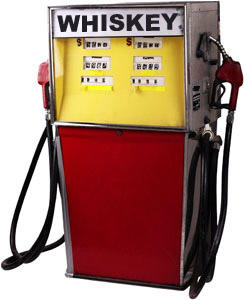
What's Whiskey Got To Do With The Price Of Gas?


When I was in the Jaycees and sold advertising for a newspaper, the editor was very active in the YMCA. They wanted to build a world class center and the first part was an Olympic size pool. He asked me if we could man the phones and solicit donations. The local phone company was willing to give us an area to make calls. I said I would bring it up at the next meeting.

We ended up with about 9 members willing to participate. When we went to the phone company, we each got a stack of 3x5 file cards with names, addresses and phone numbers. I started off by asking people for $25-50 toward the building of this pool. They all said, "No, we can't afford it right now." After about 4 calls, I knew I had to change my spiel. I then told them that we needed $150,000.

"Well, how much do you want from me?" they asked.

"Oh, $1,000 or $2,000 would be nice."

"NO WAY!" they screamed.

I said, "OK, how about $50?"

"Oh, OK, I can handle that."

I ended up collecting the most money that night, and the editor told me he had given me all the deadbeats because I sold advertising for his newspaper. He wanted to see how good I was. That is not my point, though. My point is that if you aim really high, invariably, you will get some amount from people. Sometimes, more than you thought you would ever get.

In the mid-seventies, I had a roommate who worked for a family owned liquor store. He told me about a name-brand whiskey that played mind games with its consumer base. It might have been Jack Daniel's. I don't remember for sure. A few years earlier, I had gotten sick to the point of wanting to die from drinking way too much Wild Turkey. Ever since that time, I can't stand the smell of whiskey of any type, let alone drink it. It's kind of like lamb. You either like it or you don't even want to smell it cooking.

In any event, Pete, my roommate, told me how this whiskey outfit would charge about $8.00 (back then) for a quart or whatever for most of the year. That was before we went metric. Then they'd jack the price up to around $12.00 a bottle. It would remain that way for a couple of months, then go back down to $8.00. What this, in effect, created, was a false sense that you were getting a really good deal when the price was at $8.00. People would scoff it up in anticipation of the impending price hike. This made product sales skyrocket through the roof. People would horde the stuff like it was going to disappear forever. Of course, being the gluttons that most people who need to horde alcohol are, they soon ran out and the price was then back up to $12.00 and they'd buy it again anyway. Eventually, they'd leave the price at $12.00 and raise it to $16.00 and start the whole cycle over again. At that point, people would think they were getting a good deal at $12.00, because over time, they adjusted to and had become comfortable with the $12.00 price, since they had seen it time and time again.

I think there are similarities here between that whiskey deal and what's going on with gas. Gasoline prices have been hovering around $3.00 per gallon of late. All of a sudden, I saw a gas station selling it for $2.49. WOW! Such a deal. I know the whole thing works on supply and demand, but, I kind of think of those gas guzzling SUVs as the heavy duty gasoholics of the world. They just can't seem to get enough. So, will we get used to, let's say, $3.00 a gallon, then $3.50, then back to $3.00 a gallon for a while, until it finally goes to $3.50 and stays there until the next price hike? Just a thought, but, it's not like I've never seen it happen before.

Friday, September 16, 2005

You're a B&H!


My sister is a little over three years younger than me. When I was very young I used to tease her incessantly. I was pretty nasty at times. I'm not a bad guy. I don't know what prompted me to act the way I did, but I was really mean to her sometimes. Maybe that's the way young boys are to their baby sisters.

We used to live on a farm in Ringoes, New Jersey. There was a barn not far from the house. We used to climb up on the roof of the barn just because we could. One day, I took a bed sheet with me and told her to hold it and jump. "You'll float down. It will be just like a parachute," I told her. Fortunately, she didn't do it or I wouldn't have had a sister to harass after that day. I mean, it was probably three stories tall. And she's a blonde.


She was quite the avid doll collector. She had all kinds of them. What did I know about dolls? The only one I recognized was Barbie. She became the object of my desire. By that, I mean, she became my attack doll. Poor Barbie. I don't know how many Barbies and other dolls she had, but, back then, I was an army of one. I used to take them apart and leave them that way in her room, all scattered about. She'd come in from playing with the neighbor girls and find doll heads dangling from the ceiling, where I would tie a string around their necks and tack them up. Boy, would she freak. My mother would make me put them all back together again, but it was fun to see her reaction. Before I knew what a "mature" Barbie was supposed to look like, I would pencil in nipples and pubic hair. I wasn't even old enough to know what pubic hair was, but I drew it anyway. Maybe, I had stumbled upon some father's nudist colony magazines. Boys were good at finding that kind of stuff.


One time, my father sent my mother to a tire store. Back then, not many women worked. They were stay at home moms. Right next door, there was a business called B&H Welding. We were just sitting in the car patiently waiting for Mom to come out. All of a sudden, I blurted out, "You're a B&H." She wasn't quite old enough to read.


"What did you call me?"
At that age, you tend to get more out of the tone of a voice than what you are being called.

"I said, you are a B&H!" My voice got heavier and meaner. "B&H!" She started to get upset. The more upset she got, the more I called her that.


"B&H!"


"B&H!"


By this time, she was crying, but I was relentless. "You're nothing but a no good B&H, you B&H, you."


By the time our mother came out, she was bawling her guts out, screaming like a banshee, all red in the face. "Hey, what's going on out here? What's wrong, Sweetie?" my mother asked her.


"David called me a B&H!" She knew I was going to get into trouble.


"What is a B&H, David?" she asked sternly.


"I don't know, Mom. It's that welding shop next door. I don't know what came over her."


My mother calmed her down. "Don't worry, it's nothing. It's not a bad word. It doesn't mean anything," she said in a comforting voice while hugging her.


In the meantime, I was waiting for that all too familiar "You just wait for your father to get home" phrase I would often hear. That usually scared me into my senses for a couple of days, since I knew what the sound of a belt was like sliding out of a pair of pants.


I don't remember now if I did get in trouble that day, but, Maggie? I just want to apologize for doing all those rotten things to you back then.


And you know what? You're not a B&H and you never were one. You're a...

Wednesday, September 14, 2005

Men's Room Nervana


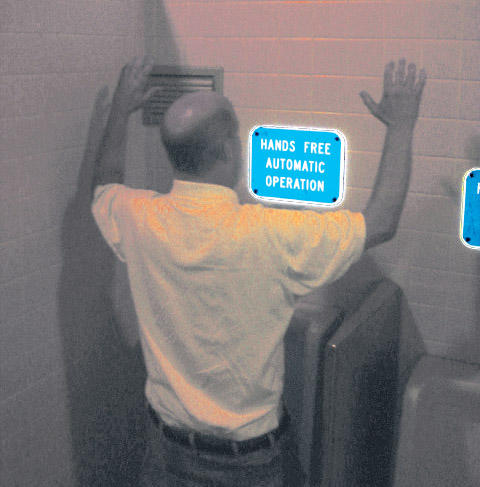
On a recent excursion, I found this rest room.
It was the most memorable moment of the trip.

Monday, September 12, 2005

The Civil Way


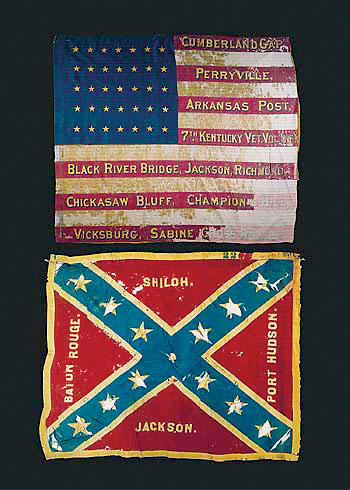
I've always had an interest in the Civil War. I grew up in New Jersey and that part of history was all around me. So was the Revolutionary War, and I am fascinated by both. There's something about living in a house that George Washington slept in. Ol' Georgie, he slept around. We had more of that war's history there than the Civil War, but that is the one that intrigues me the most.

I guess it's part of man's inhumanity against man. Wars between countries are more easily justified and explained than wars against fathers and sons, brothers against brothers and so on. I could never quite figure that out. Since I grew up in the north, I had more knowledge of the Federal government's take than the Confederacy's. The Blue against the Gray. I know there were many issues that caused it, not just slavery. Trade, for example. I'm not going to write a history lesson here. If I could ever believe in reincarnation, then I died in that war. I don't know which side I fought for and I don't care, either, except that slavery would have helped me choose sides if I was that knowledgeable at the time and my mind wasn't persuaded by one's natural inclination to route for the hometown. Neither side actually won in a sense that, either way, we would have come back to one country, united. Slavery would have had to have been abolished because how much longer could a nation suffer through that form of intolerance? We as a nation lost an awful lot, but we grew infinitely stronger because of it.

I have lived in Florida for almost half of my life now. I know the sentiments lean heavily toward the south for obvious reasons. I have heard the old battle cry.

That's one of the reasons I was so impressed as I drove through the Gulf states on my way to Houston. To witness firsthand the elegance of the homes was impressive enough, but Beauvoir, Jefferson Davis's retirement home caught my attention. All my life growing up, I saw artifacts from the north, never from the south. Clearly, it's a regional thing. It all depends on what part of the country you grew up in. Although Gettysburg honors all war dead, it is still where the northern president made his most famous speech. Throughout history, Robert E. Lee is still the defeated general. Jefferson Davis is still the non-president, imprisoned for a short period of time.

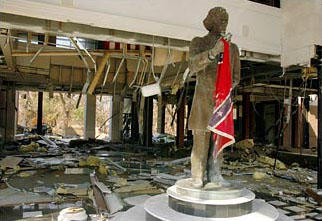
We took these scenic routes along U.S. 90 enroute to Houston to pretty much just get a glimpse of the Gulf coast. I never knew what I was going to see and when I did, it totally fascinated me. I made myself a promise to return one day soon to explore the rich history so inherent there, but, alas, that is not to be for a long time. I want to sense the moments President Davis spent in that home, writing his memoirs, relaxing on his front porch and taking in the smells of fresh Gulf air. Watching the steamships drift into the night. A lot of the Davis artifacts are gone. The nearby war veterans hospital next to Beauvoir, which had been converted into a museum, was wiped out. The memorabilia is gone. There were so many things to see, so many pieces of history now washed away by that horrible storm.

Man will fight man. Hurricanes and other manifestations will come to destroy us, but nothing will take away the heart and spirit that drives us to continue each and every day. We will always rebuild what was lost. We need to keep history alive for future generations. It's just our nature to be this way because we are a nation united and because we care so much.

Friday, September 09, 2005

Taking the wind out of Rev. Al Sharpton's sales pitch


During "A Concert for Hurricane Relief," when Kanye West went off script during the live broadcast, he stated that "George Bush doesn't care about black people."

As far as I'm concerned, everyone has a right to their opinions. This was not the proper forum to voice it, though. To risk alienating viewer donations defeats the whole purpose of the charity event. Imagine the millions of dollars that potentially were lost because of his blatant outcry.


This leads me to Rev. Al Sharpton's position of defending him. Wouldn't one think that the good reverend would have taken a different stance? One that might insightfully conclude that the possibility of risking a monetary loss in donations jeopardizes the very same people West and the rest were trying to benefit.


In my opinion, Rev. Sharpton is discriminating here. Keeping it within that political perspective, reverse the situation. Suppose a person of a different ethnic persuasion were to state, "Congressman Jesse Jackson, Jr. doesn't care about white people," and someone else of Sharpton's stature were to come along and defend that statement. How would he react? Would he still agree that the hurricane benefit concert was an appropriate place to make such a claim? I think his wind would be spinning in the opposite direction.

Wednesday, September 07, 2005

Prickle Down Theory


The prickly pear cactus was imported from its native South America to use as natural fencing in Australia to keep herds of cattle in check. It spread quickly and soon got out of hand. In the 1920s, the cactus moth (cactoblastis cactorium) was used extensively to stop the prickly plant from overrunning the Australian Outback. As a biological plant control, the moth was hugely successful. It was later used in other regions, including the Caribbean, to quell growth of the prickly plant.

It was such a short jump from the Caribbean to the Florida Keys for the moth, that in the late eighties, it soon migrated to the North American mainland. Scientists became increasingly alarmed at the advances the moth had made. It was imperative to stop it at a designated line of demarcation in the Florida Panhandle and Alabama; to keep the moths from heading into the Gulf coast, the Southwest, and onward into Mexico, where the cactus is vital to agriculture, horticulture and the environment.


Hurricane Katrina could have set back the methods utilized in stopping the moth from advancing. Fears have arisen that the cactus pads and moths, which consume the cacti in its caterpillar stage, have broken off from their habitat in Dauphin Island in Alabama, near Mobile, and are now scattered all around the Gulf. Katrina devastated Dauphin Island. They may be floating aimlessly toward areas they were supposed to stay away from. Currents may wash the moths ashore, where new generations may reproduce this fall. They could then move inland.


Dauphin Island was crucial in stopping the moth. It is the last barrier island where you have good access by road. There, and Santa Rosa Island near Fort Walton Beach in the Panhandle, tests were being conducted to stop them. This was also a means by the USDA Agricultural Research Service to use natural methods instead of insecticides that have proven to be ineffective.


The USDA estimates that the prickly pear industry in this country is worth $70 million annually, mostly in the Southwest where it is used mainly for foraging and landscaping.


In Mexico the fruit is consumed and usually is pickled or boiled. There, the industry is valued at up to $100 million annually, not counting what people do on their own by picking it for themselves.


Now, I'm not going to call this a potentially life threatening event or something we should lose sleep over. The sky's not falling. It's not a proven fact that this is absolutely going to happen. But, Katrina was the most horrible natural catastrophe to occur in my lifetime and I'm just trying to point out that it is going to affect our lives in ways we are not even capable of comprehending yet. The prickly pear dilemma is just one of the many small things that might impact people in silent ways you just won't read about on a daily basis.
All of those small things add up.

Katrina will leave us in a pickle and I don't feel too Kosher about that.

Friday, September 02, 2005

The Fate of Beauvoir and A State of Anarchy


UPDATE 9/8/05

New information on Beauvoir, from the Wednesday, September 7, 2005 Newark (NJ)
Star Ledger By Suleman Din, Star-Ledger Staff:
BILOXI, Miss. -- Beauvoir, the seaside retirement estate of Confederate President Jefferson Davis, stood for more than 150 years as a great example of Southern architecture and antebellum lifestyle.

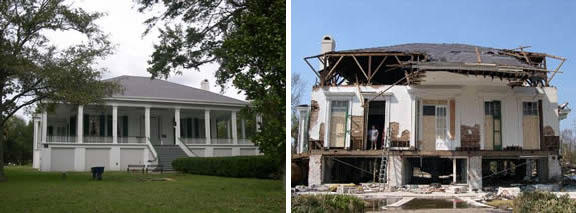
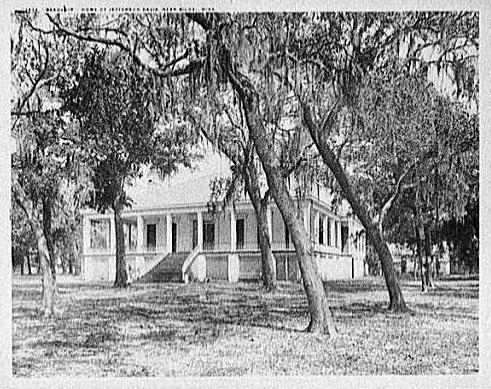
With lawns shaded by tall oaks, cedars and magnolias, Davis' cottage was simple in design but elegant in detail. A tapered staircase led to the center of its extensive wrap-around porch. The front door was cut glass, the windows covered by louvred green shutters. The building was painted bright white with green trim.

Just nine months ago, the historical society that maintains the grounds finished repainting Beauvoir's numerous chimneys and shutters, reattaching the shutter frames, and installing a lift in the back for disabled visitors.

"It was looking its best in 50 years," said Patrick Hotard, the historical director of the house, a state and national landmark operated by the Mississippi Division of the Sons of Confederate Veterans. "Now I feel like we are even before square one. I've been working here six years, and you get attached to a place. It's very trying on the emotions. It is one of the last great old houses of the South."

Early reports out of Biloxi said the cottage, which houses Davis family furniture, art, and archival items such as letters and artifacts, had been leveled, but Richard V. Forte, chairman of the Sons, was happy to paraphrase Mark Twain, noting such reports of Beauvoir's demise were greatly exaggerated.

"I am confident that it will be rebuilt," Forte said. "It's just a matter of cleanup and restoration."

The winds and storm surge of Hurricane Katrina did damage the home heavily: The porchline and front steps are entirely gone, part of the roof is torn away, windows are smashed, and the back portion is crumbling. Floodwaters water pushed many of its artifacts out into the mud, where some of them were stolen.

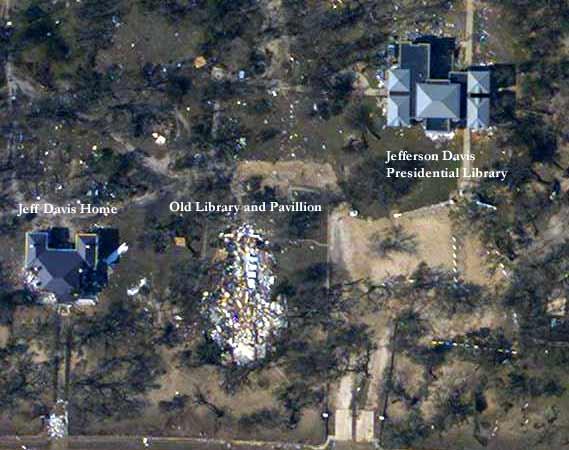
Other buildings on the 52-acre site fared worse. The war veterans hospital next to Beauvoir, which had been converted into a museum, was flattened, along with two matching pavilions that stood in front of it. A marble monument that framed the brick walkway to the home was broken. The Jefferson Davis Presidential Library, built for $4.5 million in 1998, had its first floor washed out.

Davis holds the distinction of being the only president of the Confederacy, but the West Point graduate was also known as a hero in the Mexican War of 1847. He was a congressman and senator, and was secretary of war under President Franklin Pierce.

He was captured by Union soldiers in 1865 and jailed for two years. He moved to Beauvoir in 1877 and lived the last years of his life there, writing his memoirs. He died in 1889.

Beauvoir -- French for "beautiful view" -- had been built in 1851 and went through the Civil War unscathed. But Hurricane Camille damaged the home extensively in 1969. Forte said the cottage's raised design is what saved it from being washed away then, and now.

"They knew what they were doing back then," Forte said. "The way they built that cottage, it lets the water and air go right under it."

Still, the place is a wreck, and Forte and Hotard had no estimate on the cost of repairs.

"It's going to be very substantial," Hotard said.

Forte said that because Beauvoir is a historical landmark, there will be grants available for reconstruction. Private donations also will be solicited, he said. The Friends of Beauvoir have set up a fund for those wanting to help reconstruction efforts.

Architectural experts have been brought in to examine the building and see what can be recovered.

Many valuable pieces inside the home, such as portraits of Davis and his family, are still intact, Hotard said.

The hospital museum, now in rubble, housed a priceless collection of military artifacts from Confederate soldiers, including uniforms and weaponry, and much of that was stolen when the walls came down.

Forte said that the historical society has provided a list of missing items to eBay, so that if any appear for sale, they can be confiscated and returned.

"There is a market for these items," he said. "That's just an unfortunate human trait, and I don't understand that why someone would steal from a home, especially this one."

To prevent further theft, the grounds are now guarded by Beauvoir's own security people and the army.

Bertram Hayes Davis, the great-great-grandson of Jefferson Davis, said the family is relieved that enough of the structure remains for restoration efforts.

But right now, he said, the family is more concerned for the people in Biloxi and along the Gulf Coast who have lost their homes and their loved ones. It's what Jefferson Davis would have felt, he said.

"He would have put the needs of others first," Davis said. "The home can be reconstructed. Beauvoir will be a part of the Gulf Coast for hundreds of years to come."

Suleman Din may be reached at sdin@starledger.com.


This, according to a report published in the Baltimore (Md.) Sun, September 1: Regarding damage to Beauvoir, the Jefferson Davis Presidential Library in Biloxi, Mississippi, John Hildreth of the National Trust for Historic Preservation, says: “It’s maybe 500 yards from the beach, Ground Zero in Biloxi. We’d heard at first that it had been destroyed, but I found out today that it’s still standing on its foundations. The galleries (porches) are gone, and there has been significant damage to the house. We don’t know yet how all the papers in Davis’s presidential library have fared.”

An illustration of Beauvoir is shown in my previous post.

There has been much news coverage of the wanton looting, rapings, muggings, shootings and other crimes being committed in the aftermath of Hurricane Katrina. Upon observation, most of these incidents have been allegedly perpetrated by a majority of blacks (or African Americans, if you prefer.) Upon investigation, I note that most of the people left in the city are not the well to do. They had no real way to escape. No car. No public transportation. No cabs. No money. They are stuck until some entity arrives to help them. The escape routes are limited. These "refugees" have been held captive in the wake of Katrina. I watched the news footage of all types of people looting stores and stealing everything not locked down. Food and water I can understand. Certain other items necessary to sustain life, of course. Medications, for example, if one suffers from diabetes or other maladies. For the life of me though, I can't understand someone stealing TV's. To watch what? You will not have electricity for a long time. Where would you take these items? Your house is no longer there or isn't livable and you certainly cannot walk out of the city with it, nor take it on the bus. The TV stations were knocked off the air. It sort of reminds me of an Eskimo stealing an air conditioner to take to the North Pole. There are always idiots out there who haven't got a clue.

Caches of guns and other weapons were stolen. There were reports of gunshots fired at helicopters. I think I can understand why this would happen. With little or no police protection, the thugs and gang leaders are attempting to control what's left of the city. The police and military are threats to them. They want control and will use whatever means they have available. The authorities must act fast and mobilize. In the meantime, how does America's society look at the rest of the populace stuck there? No one is going to be extremely rational when placed in this type of scenario. Look at what just happened. They lost about everything. Many of their loved ones could be missing. The sweltering heat is unbearable. There is no water and nothing to eat. Where can they make their next bathroom run? Next to the dead, floating or lying in the streets? They feel cornered, as if there is no way out. They are watching their relatives, friends and neighbors slowly drift away to an untimely death. Most are just fighting to stay alive. Faced with impending plagues, what would you do?

Not all people are born leaders. Many like to follow, not out of weakness, but it's just not their nature. You've witnessed now the strong who have risen up the ranks to bring about order. These are deserving souls and should be remembered. The hooligans trying to disrupt this broken down society should not be represented as the whole. They are losers of the world grasping at their last hurrahs in their own little world of freedom and they'll take down anyone who gets in their way. This has nothing to do with race. This is how the human race reacts when faced with catastrophes.

Just wait and see what happens when and if we ever start nuking each other.

Wednesday, August 31, 2005

In The Aftermath


I wrote this article today. I submitted it to the Orlando Sentinel's editorial department. It was published September 1, 2005 on their op-ed page. It is titled, New war devastates the South .

What a shame. Recently, on my way to Houston, I drove through many of those areas devastated by Katrina. On the way out, we went through Biloxi. It was like a miniature Atlantic City, right on the Gulf. Of course, all of the casinos were on barges, since it is against the law to have them firmly planted on soil. We stopped in little towns, such as Bay St. Louis, which was practically ground zero. All over, the areas were very nice, not really what I expected from southern towns. I was aware of the charms of the south, but, never realized its beauty until we exited Interstate 10 to explore the coast. Elegant antebellum and Victorian mansions, with Spanish moss draping down shady trees. Gulf breezes to cool the night. Beauvoir, in Biloxi, right on the Gulf, was the last home of Jefferson Davis and is where he wrote his memoirs and spent his final years. I can understand why he decided to make it his last home. I hope it survived.

We stopped in New Orleans and took pictures, including ones at St. Louis Cemetery #1 (See picture in "About Me" section.) I imagine it would look pretty creepy today. I had been to Bourbon Street and surrounding areas once before in the early nineties and found it to be quite charming.

Aside from byproducts such as human waste, there are many things that will poison the city and land. Leakage from chemical plants, oil from refineries and filling stations, for example, and toxins from decaying carcasses. Death and disease are all around them now. There are so many problems to face. It's too soon to make any decisions regarding the future fates of the areas so affected. One thing to take into consideration is that while Katrina headed north, dumping high levels of rain, the Mississippi will swell. The Ohio River empties into the Mississippi, too. And where is the mouth of that great river? Yes, New Orleans. That means that all of that flooding will eventually make its way back down to that city. We may wait months before the whole thing settles and there can possibly be some semblance of what to do with the entire mess.

The ports in New Orleans bring in most of the coffee we drink, shipping to New York and elsewhere. That is just one product. Imagine, overall, how much damage will be done to our national economy, which is already looking at some major issues. Insurance companies will have to dole out billions of dollars and we all will have to pay.

In the meantime, the Gulf communities east of New Orleans will have to tear down the old and start again. Millions will be without power. Many will not go back to their old jobs for a long, long time. What will happen to all of these people who lost everything? Where will they go? Will we open our hearts and homes to let them in? What can we, as a nation, do? The Civil War has long been over. Hurricane Katrina declared war on this region, so rich with history and hospitality, and it is time that we all help and declare that "The South Shall Rise Again."

Monday, August 29, 2005

PLEASE HELP IF YOU CAN


Having recently driven through the Alabama, Mississippi and Louisiana areas now going through a terrible hurricane, I can really empathize with the people who live there. I know how fragile these places are. Believe me, I live in Florida and did not have a pleasant time with the ones that passed our way last year. We went through Charlie, Frances and Jeanne. Ivan missed us, but, really nailed the Panhandle. Do you know what it's like to not have electricity or running water for a week? No air conditioning. No ice. Long, exasperating lines at gas stations before the storms hit. Businesses closed for what seems an eternity. Fallen trees and power lines. I think they're going to have it rougher.

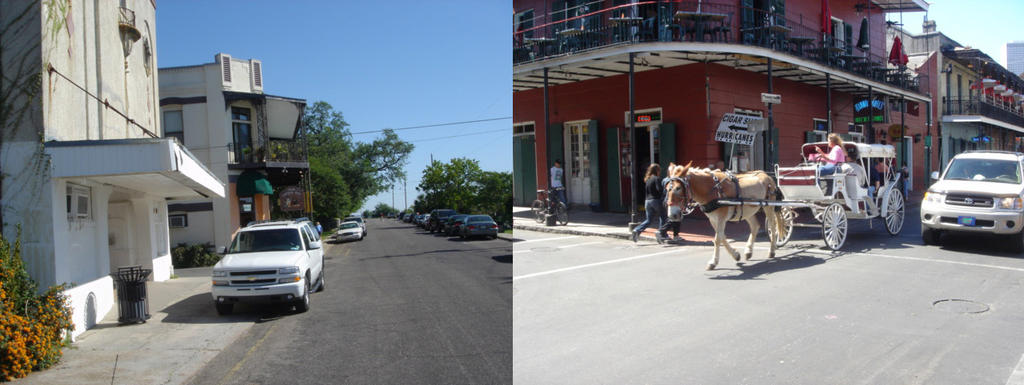
The two pictures above are from my trip. The one on the left is a quaint little community called Bay St. Louis, in Mississippi. They should get the brunt of the damage from Katrina. Them and Pass Christian. On the right is a shot taken from the French Quarter. It does not look like that today.

Hurricanes are horrible things. Maybe Pat Robertson had something to do with this, loving Christian that he is. After all, there's them there cat houses and gambling halls down that way.

Friday, August 26, 2005

I'm Going Into Radio, Trust Me.


In the 1970's, when I managed Weiner King restaurants in New Jersey, a young fellow came to work for us by the name of John Weber. John was one of those guys who was really nice. Nice almost to a fault. Always polite, the customers loved him. For years, he told me he would one day go into radio broadcasting. He and I got along great. At one time, I thought I would go into radio. I was attending Trenton State College (now The College of New Jersey) and I dabbled a little bit on the college radio station, WTSR, 91.3 FM. A guy I knew there, Kevin Clemente, had a regular program and I used to stop by after classes and sit in with him in the broadcast booth. Once in a while, he'd let me do the news or weather, so I had a little experience in it. Back then, I had an extensive knowledge of music. I impressed many of my friends and co-workers with my musical expertise, including John Weber. John and others always told me I should go into radio. My voice was certainly pleasant enough for it, but, John's voice was truly designed for at least radio, if not television. Time and time again, he would tell me, "Dave, one day I'm going to be on the radio."

When it came to sports, besides Howard Cosell, back then, I didn't know anyone who knew more about sports than John Weber. Any sport. He would awe you with his list of statistics, where athletes grew up and what schools they attended and just about anything else pertaining to sports. Especially the New York Yankees. Boy, did he know them. It was a national day of mourning when Thurman Munson died in that tragic plane crash. John wasn't quite the happy-go-lucky guy for a while after that.

I haven't talked to nor seen John in over 25 years. Recently, a very close friend of mine, Frank Foran, found his e-mail address and contacted him. In his response, John asked about me and quickly wrote an e-mail. In it, he says, "I've managed to eke out a career in broadcasting and am actually fortunate to work for the most listened to FM talk station in the nation, New Jersey 101.5 FM Radio . I anchor the news on NJ 101.5, do the morning news on WBUD AM in Trenton and WIXM FM in Atlantic City as well as the 12 station Millennium Radio Network of New Jersey radio stations which are completely separate newscasts than the afore mentioned stations. Its all done from our studios in Ewing Township right near The College of NJ which used to be Trenton State. I have one of those weird radio shifts that starts at 4:00 AM, but I am out by 11:00 AM on most days unless there is breaking news at The State House or somewhere."

He is happily married, with two children. What's ironic about it, though, is that I used to sell advertising for a local newspaper, the Hunterdon County Democrat, and he did the same thing for a while. His wife is there now doing the same thing. It's nice to come back into contact with old friends and learn that at some point in life, we led similar lives with regard to some of our jobs, except that he did go into radio and I went into the art field. He did end up doing exactly what he told me he would do. Hot Dog! It couldn't have happened to a nicer guy and I always wish him continued success.

My only advice to John is that, if you ever get tired of the radio booth, why don't you go get a job as the New York Yankees announcer?

Tuesday, August 23, 2005

Gator Tales & It's A Small World After All


Quite a few years ago, three of my friends, Stewart, Frank and Pat, came down from New Jersey to visit. I remember before they got here, one of them asked me if my car had air conditioning. "Of course," I said. When I picked them up at the Orlando airport, they said, "Hey, I thought you told us your car has AC." I said, "It does, but, you didn't ask me whether it works or not."

For months before they got here, I kept telling them about this terrible gator problem we were having. Gators everywhere, strutting up to homes and snatching little poodle dogs away from their owners. "Yelp! Yelp!" A real epidemic. They believed me but it did nothing to stop their trip. Stewart knew better. We've been friends far too long and he can tell when I'm full of it. I think, in the years I had been in Florida, up to that point, I had only seen one in the wild, while canoeing on the Wekiva River.

One of the features of the greater Orlando area back then, was, that it had an abundance of dancing facilities of the female persuasion where the uniform consisted of just high heels. The only time I ever went to those places was when my married friends would come down to see me. They insisted. I felt a little arm twisting and they were so persistent, so I reluctantly gave in. "Hi, Dave," one of the girls said as we entered an establishment in Fern Park. We locals referred to it as the "Fern Park Ballet."

This particular time they came down, they wanted to go to EPCOT. Fortunately, I have enough friends here to get me a free ticket whenever I need one. Having lived here so long, I had been there enough times and didn't want to particularly go, but, heck, a free ticket's a free ticket, and I couldn't let them go without me since it was me they came to see. We got to EPCOT bright and early, paid the parking fee and waited in line. I told them we need to get there early since the lines get very long and the overwhelming crowd can keep you from seeing as much as you want to in a day and, besides, we might want to get out of there early. While we were waiting to get into the park, my friend Stewart asks, "So, Dave, you think there are people from all over the world here?"

"Of course, and I wouldn't be surprised if someone from Flemington was here, too." Flemington is where I was from and where these guys lived. Old time friends.

"Nah, no way," Stewart replied, "If anybody from Flemington's here, I would know it."

All of a sudden, the gates opened up and we were all flowing in. Frank is about 6' 4" give or take an inch, so he towers above the rest of us. "Burgers Cycles, 782..." he says, "Hey, I see someone up there. It couldn't be..."

"What," I asked, "the motorcycle shop up on Route 202 heading to Three Bridges?" We tried to catch up. We followed as best we could. They were heading toward the American pavilion, along with hundreds of other people. As we got to the entrance, the young girl closed the door and announced that they were full and the next show was in about 45 minutes. My friends started to turn around and walk away. I said, "No. Wait." When the remaining crowd dissapated, I asked her if we could go in. She told me no, but, I was insistent. I told her about my friends visiting from out of town and what Stewart told me, that if anyone from Flemington were here, he'd know it. I wanted to prove him wrong and, besides, four more wouldn't hurt anything. "I mean, you didn't actually take a head count, did you?"

"No." She looked around. "OK, go ahead in." We scurried in to the tail end of the line, looking into that vast crowd.

"Oh, no way are we ever going to find that shirt," Stewart said. He underestimated the power of Dave. As we all filed into our rows and sat down, who do you think is sitting right in front of us? I mean, directly in front of us. Morris Postun. We all knew him. Worked at Burger's Cycle Shop. He brought his mother down for a nice little vacation. What a great guy he was for taking good care of his mother like that and having Stewart eat his words. Thanks, Morris.

I don't remember how many days they were here, but, my sister, Maggie and her husband, Bud, had a sailboat they kept on the west coast, near St. Petersburg. Wanna come sailing with us? Great idea, so we all headed toward St. Pete. Back then, long before Bud got sick, he was quite the avid sailor. Maggie helped out a lot, too. He always gave us little responsibilities to get us involved in the sailing. Stewart was the most experienced from our crowd, having grown up around boats. Pat was probably in charge of drinks. Frank was in charge of music on the portable stereo. Stew and I manned the boat with Bud. The stereo was out on the bow. We had started to move at a decent clip, probably around seven knots and the boat started to heel. Frank had forgotten about it. A cassette tape of classical music was playing 'Flight of the Valkyries.' All of a sudden, we watched in horror as the radio slid from the boat into the water. We couldn't stop it. It continued to play as we tried to come about to save it. By the time we got close, it slowly had sunk into the depths of Davy Jones' Locker, but, it continued to play, "blub, blub, blub," until it was out of sight. I guess it's a shrimp reef now, somewhere in the Gulf of Mexico.

On our way back from the coast, they had noticed picket and other assorted fences around many of the homes and businesses. One of them asked me if that was to keep the gators out. I had a tough time holding it back.

"Yes. That is the only reason why people put fences up in Florida. Those gators are everywhere." Needless to say, not one of them saw any gators while they were here.

Stewart and his wife now live on the west coast of Florida, just south of Port Charlotte and they have 2 gators in their back yard, right on the golf course, near the retention pond. They've only been here since June of last year. I've been here 24 years and they've already seen as many as me, in the wild, that is. That's them, up top. Go figure.

Wednesday, August 17, 2005

Fishin' with Frank on Cable 68


When I moved to Orlando from New Jersey, my old friends from up there came up with the idea that we would have an annual party, like The Big Chill movie. All or most of my good friends would meet every summer at the beach house in Beach Haven, NJ. My best friend, Stew's, parents owned it, so we never had to worry about finding a place. Every year, we would all take turns with the video camera and I would edit it into some kind of form that would make sense. It was filled with all kinds of things. I could take a comment made about a model or movie star and splice it into another area so it seemed like someone was commenting on someone else's wife. All kinds of stuff, I did with those videos. Everyone couldn't wait to see my finished product.

One year, I decided to shoot a segment about my good chum, Frank. Frank has always been quite the fisherman. Why not conjure up something and call it "Fishin' with Frank." It has a nice alliteration to it. I worked for an ad agency, so creating art for it presented no problem. I designed a title page that depicted a fisherman on a boat who looked like Frank casting out to sea. For the opening scene, where I did the voiceover, "Yes, it's time for Fishin' with Frank," the camera focused on a pool of water. Then, SPLASH! and clunk as the lure and lead weight was cast into the inside of a toilet bowl. As soon as it hit the water, the toilet was flushed and the camera slowly panned upward to the open lid, which had the picture of Frank carefully taped to it. The next scene was Frank peeing off the stern of the boat. Of course, he was really just spilling a beer can of water into the ocean. "Frank! Frank! You're on!" He pretended to pull his zipper up on his shorts, turned around and introduced himself. Frank knows his stuff. He talked about...fishing! We had the requisite bikini clad babes, who were all wives and girlfriends. We were a lot younger then and they sure did look good. Not that they don't now. So, we had a lot of shots of the girls. Which was a whole lot more important and exciting to watch than Frank. Margaritas flowed. Music wafted in the background. We all took our turns fishing. Of course, the best scenes were when Frank tried to teach some of the girls how to fish. The camera kept moving toward the women's bodies. "Dave! Move that camera here, !#$T#$!*@. I'm trying to show how to tie a knot." Oh, yeah. OK, Frank. Right. That's how it went that day out in the Atlantic Ocean. We all learned something from Frank that day, like, how to talk like a sailor when the camera's not where it's supposed to be. Thus was the taping of the world premier video of the almost famous program, Fishin' with Frank on Cable 68, out of Vineland, New Jersey. Of course, there was no such thing as Cable 68.

After we all got back from that excursion, we cleaned up and went to Buckalew's Restaurant & Tavern for dinner and drinks. They sure did know how to make a great tavern pie there. We sat in the tavern part where they have booths. One side has a long booth and chairs opposite the tables, so we could all sit together. There must have been 20 of us. One waitress asked me who we all were. Wrong question to ask me. "Why, have you ever heard of the Fishin' with Frank show on Cable 68?"

"Yes, I'm pretty sure I have."

"Great. We just taped a show up here to be broadcast next month. That's Frank, over there." I pointed Frank out to her. Frank is a pretty tall and good looking guy, so he can have a commanding presence. His uncle was a Hollywood actor named Dick Foran. His father was a senator.

That started the whole theme of the evening. That one waitress had everyone sitting at tables and the bar scrambling to talk to Frank and get autographs. One woman came up to me and asked, "Are you the producer?"

"Yes, I am," I stated as she thrust a paper placemat and a pen toward me to sign. "I thought so," she replied. It seems that everyone had heard of the show, or seen it. The amazing power of suggestion and a whole entourage of "production people." We never took advantage of anyone, nor accepted free drinks, but, it sure was hilarious.

I don't remember if we really caught any fish that day, but, I'll bet you, as Frank always would, that he would have caught the first, the biggest, and the most on the maiden (and only) voyage of Fishin' with Frank.

Tuesday, August 16, 2005

John W. Fountain

I read in the Sunday, August 14, 2005, edition of the Orlando Sentinel, an article titled, "Black Men Disengage From Church," by John W. Fountain. I read this with great interest and a strong feeling because I can relate to most of what he said. Although I am white, his words ring true in my heart.

My grandfather, like his, was a preacher. He was with the Church of the Brethren for sixty some years, until his death at 93 in 1998. The Amwell Church of the Brethren, in Sergeantsville, New Jersey, welcomed people of all faiths and ethnic backgrounds. I grew up with strong feelings of, "...Be they yellow, black or white, Jesus loves the little children of the world." That is what was taught to us. All were welcomed here, rich or poor. I have no reason to believe it is any different today.

My grandfather went to his grave with the same Spirit that chose him to preach the word of God. He was a simple man, in that, he never aspired to a higher calling from the god of material wealth. He lived off meager wages. The church, every ten years or so, would buy him a new Mercury. The material things he took from the congregation were very tangible. Every once in a while, some of the ladies would bake my grandmother and him a pie or two. He did enjoy his 10 or 20 percent discount that stores and restaurants bestowed upon all men of the cloth.

As a child growing up, a majority of the congregation consisted of women. I remember it has always been like that. Not 75%, though. That is high. The women would fan themselves during hot summer months with the church bulletin. I remember mothers making excuses for their husbands, too, why Daddy didn't go to church. Daddy's got too much work to do.

Many years ago, back in the early 60's, my older brother and I belonged to some type of boy's group, similar to the Boy Scouts, but, not that organization. I don't recall the name of it, but, it was church-based and the meetings were held in a nearby church basement. One time, the preacher came out the front door as my brother was attempting to enter. The preacher told him to step aside. Do you know who I am? It was like the CEO telling the mail room clerk how unimportant he was. That impacted us. We were not brought up in a world of egotistical pastors. We stopped going.

I have lived in the Orlando area since 1981. There are many huge churches here. This is the south and there are many denominations that support large congregations. One that was under construction had massive pillars. Someone spray painted in large letters, "God is not impressed" on one of those pillars. I kind of got a chuckle out of that. Many of these preachers live in multi-million dollar mansions, drive expensive and exotic cars and enjoy the finer things of life, along with maintaining strong bonds with local politicians. This is why I left that realm of religion behind. My faith may still be here, but, this is not the God I know. Not all churches and their ministers are like that, either. Some grew because their congregations grew, also. They had no choice but to expand. They still embody the same visions that came with their inception, only on a larger scale. But, many times, along with that growth comes power, and power is one of the most corrupting things on earth.

Many churches have turned away from their humble beginnings. I think they inherently mean well, and they still do many wonderful things, but, they have somewhat turned away from the underlying message of faith, love, hope and charity, and turned it into some sort of distorted greed. They still preach the message and the flocks still follow, but, the larger and more indulgent mansions of God they build move them farther away from the people they are there to serve. Many members of these churches expect their leaders to enjoy upper class living. But many do not. Are they as active in the community as they could be? Or are they above that now? Do they help the alcoholics, drug addicts and indigents as strongly as they can or do they shun those who do not live up to their standards of God? Dear Lord, don't let them near me. It's like politicians. They are there to serve their constituency, not themselves, whether those in need voted for them or not, and whether they support them or not, too. The church is a servant of God and God ministers to the needy. Church leaders should never rise above that precept.

Why is it that people scrutinize charitable organizations about how high their administrative costs are before making donations, yet these same people do not question what happens to what they drop in the offering plate week after week?

Unfortunately, smaller churches don't have the working capital to help as much as the larger ones. I wonder if smaller community churches could band together to help those in need? Ten small churches offering $100 a week would be $1,000 to charities of their choosing, or whatever they all agree they can afford. Every week it could go to a different cause or outreach program.

I hope his article is read by many. This is a powerful message for people of all faiths and ethnic backgrounds. It's an especially excellent read for those sitting in the hot tubs of their giant mansions, sipping on cold glasses of expensive bubbly, while watching themselves on giant screen televisions. In high definition.

His article can be read HERE .